Stock Market Basics
Small Cap vs Mid Cap vs Large Cap: Understanding the Differences
Feb 15, 2026
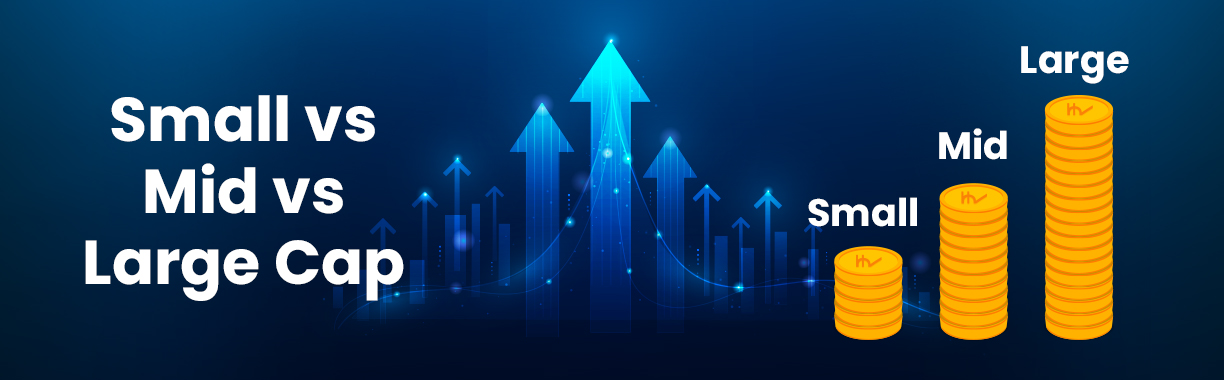
If you have ever looked at stock market discussions or mutual fund categories, you probably have come across terms like small cap, mid cap, and large cap. These categories are based on a company's market capitalisation and help classify businesses by size.
Understanding the difference between small-cap vs mid-cap vs large-cap stocks is essential for assessing risk, return potential, and suitability within a diversified portfolio. This article explains how these categories differ, how they behave in varying market conditions, and what investors should consider before allocating funds.
What Does "Market Capitalisation" Mean?
Market capitalisation or market cap for short, refers to the total market value of a company's total number of shares(outstanding shared).
How is Market Capitalisation calculated?
How is Market Capitalisation calculated?
Who is classifying companies by Market Capitalisation?
Regulators, such as SEBI in India's stock market, classify companies into large-cap, mid-cap, and small-cap categories based on their ranking by market capitalisation. Broadly put:
- Large-cap companies are the biggest and most established.
- Mid-cap companies are medium-sized firms with growth potential.
- Small-cap companies are smaller firms, often at an earlier growth stage.
Understanding this classification helps clarify the difference between large, mid and small- cap companies beyond just their size.
Large Cap Companies
Large-cap companies typically are ones that rank among the top market capitalisation is the top 100 listed companies.
Key Characteristics of Large Cap Companies:
- Established businesses with proven track records
- Strong brand recognition
- Stable revenues and earnings
- It has lower volatility compared to smaller companies
Example: A well-known multinational bank or energy company listed on a major stock exchange would generally fall into the large-cap category.
Risk and Return Profile:
Large-cap stocks are often considered relatively stable. They may not offer extremely high growth, but they tend to provide steady performance and, in many cases, dividends. When you are comparing small cap vs mid cap vs large cap, large caps are usually seen as suitable for conservative investors seeking long-term stability.
Mid Cap Companies
Mid-cap companies typically rank between 101 and 250 by market capitalisation.
Key Characteristics of Mid Cap Companies:
- Growing businesses with expansion potential
- Moderate market presence
- Higher growth potential than large caps
- Moderate volatility
Example: A regional pharmaceutical company expanding nationally could be categorised as mid-cap.
Risk and Return Profile:
Mid-cap stocks sit between stability and growth. They can deliver higher returns than large caps over time, but they also have more risk.
In the context of large-cap and mid-cap comparison, mid-caps often provide a balance between safety and aggressive growth.
Small Cap Companies
Small-cap companies rank below the top 250 by market capitalisation.
Key Characteristics of Small Cap Companies:
- Smaller or emerging businesses
- Limited operating history in some cases
- High growth potential
- Higher price volatility
Example: A newly listed technology start-up with a niche product may fall into the small- cap category.
Risk and Return Profile:
Small caps can generate substantial returns if the companies grow successfully. However, they are also more vulnerable to economic downturns, liquidity constraints, and operational challenges.
When analysing small-cap vs mid-cap vs large-cap stocks, small caps are typically associated with higher risk and higher potential reward.
Comparative Overview of Small-cap vs Mid-cap vs Large-cap
The table below summarises the main differences:
| Feature | Large Cap | Mid Cap | Small Cap |
|---|---|---|---|
| Market Ranking | Top 100 | 101–250 | Below 250 |
| Business Stability | High | Moderate | Lower |
| Growth Potential | Moderate | High | Very High |
| Volatility | Low to Moderate | Moderate | High |
| Risk Level | Relatively Lower | Moderate | Higher |
| Liquidity | High | Moderate | Lower |
This table highlights the structural difference between large, mid and small cap categories from an investment standpoint.
How Market Conditions Affect Each Category
Different economic phases influence these categories differently:
During Economic Expansion
- Small caps may outperform due to rapid business growth.
- Mid-caps may benefit from expansion plans and sector momentum.
- Large caps tend to provide steady but comparatively moderate gains.
During the Economic Slowdown
- Large caps often perform relatively better due to strong balance sheets.
- Mid-caps may face moderate pressure.
- Small caps can experience sharper declines due to limited financial buffers.
Understanding these patterns helps investors make better decisions when evaluating small cap vs mid cap vs large cap opportunities.
What Should Investors Consider When Investing by Market Cap?
Before investing you invest your money in one place, it is important to evaluate:
1. Risk Appetite
Your risk appetite is your comfort level with price fluctuations. If you have a high-risk appetite, you may consider mid and small caps. Those preferring stability may lean towards large caps.
2. Investment Horizon
Small and mid-caps may require a longer holding period to realise potential gains.
3. Diversification
A balanced portfolio may include exposure across all three categories to manage overall risk.
4. Liquidity Needs
Large-cap stocks are generally easier to buy and sell due to higher trading volumes.
Mutual Funds and Market Cap Categories
Equity mutual funds are also categorised based on market capitalisation exposure:
- Large-cap funds invest primarily in the top 100 companies.
- Mid-cap funds focus on companies ranked 101-250.
- Small-cap funds invest in companies beyond rank 250.
For investors wondering what is large cap and small cap in the context of mutual funds, the classification depends on the underlying companies held within the scheme.
Is One Category Better Than the Other?
There is no universally superior option in the small-cap vs mid-cap vs large-cap debate. Each one serves a distinct purpose: large-caps offer relative stability, mid-caps provide balanced growth, and small-caps offer aggressive growth potential with higher risk. The appropriate allocation depends on financial goals, market outlook, and personal risk tolerance.
Conclusion
The comparison of small cap vs mid cap vs large cap is not about choosing one category over the others. Instead, it is about recognising how each type of company fits into an overall investment approach. Rather than choosing one category exclusively, many investors adopt a diversified approach across market capitalisations. This strategy can help manage volatility while maintaining exposure to potential growth opportunities.
Before you start investing in equities or mutual funds, consider reviewing your financial objectives, the risk you can take and consulting relevant disclosures. To explore investment options aligned with your financial goals, visit Indiabulls Securities Limited (formerly Dhani Stocks Limited) and review the available equity and mutual fund offerings.
FAQs
1. Do market cap categories change over time?
Yes, a company can move between large, mid, and small cap classifications as its market capitalisation changes due to price movements or business growth.
2. Are small-cap stocks always more profitable in the long term?
Not necessarily. While they may deliver high returns in certain phases, they can also experience prolonged underperformance.
3. How frequently are market cap rankings updated?
Market capitalisation rankings are periodically reviewed by regulators and fund houses to maintain accurate classification.
4. Can international companies also be classified as large, mid, or small cap?
Yes. Market capitalisation classification applies globally, though the specific thresholds may vary by country and exchange.
Disclaimer: The contents herein are only for information and do not amount to an offer, invitation or solicitation to buy or sell securities or any other financial product offered by Indiabulls Securities Limited (formerly Dhani Stocks Limited / DSL). The content mentioned herein is subject to updation, completion, amendment without notice and is not intended for distribution to, or use by, any person in any jurisdiction where such distribution or use would be contrary to law or would subject Indiabulls Securities Ltd. (formerly Dhani Stocks Ltd. / DSL) to any licensing or registration requirements. No content mentioned herein is intended to constitute any investment advice or opinion. ISL disclaims any liability with respect to accuracy of information or any error or omission or any loss or damage incurred by anyone in reliance on the contents herein. This blog is based on information obtained from public sources and sources believed to be reliable, but no independent verification has been made about its accuracy or its completeness is guaranteed. This content mentioned in this blog is solely for informational purpose and shall not be used and/or considered as an offer or invitation or solicitation to buy or sell securities or other financial instruments. ISL will not treat recipients as customers by virtue of their receiving this report. The securities / Mutual Fund units (if any) discussed and opinions expressed in this blog/report may not be suitable for all investors. Such investors must make their own investment decisions, based on their investment objectives, financial positions and specific needs. ISL accepts no liabilities whatsoever for any loss or damage of any kind arising out of the use of this report. Past performance is not necessarily a guide to future performance. Investors are advised to see Risk Disclosure Document to understand the risks associated before investing in the securities markets. ISL may have issued other blogs that are inconsistent with and reach different conclusion from the information presented in this blog.
Indiabulls Securities Limited (formerly Dhani Stocks Limited) is a Mutual Fund Distributor registered with ‘Association of Mutual Fund of India’ (AMFI) vide ARN number ARN-160411. Corporate Identification Number: U74999DL2003PLC122874; Registered office address: A-2, First Floor, Kirti Nagar, New Delhi - 110008. Tel.: 011-41052775, Fax: 011-42137986.; Correspondence office address: Plot no. 108, 5th Floor, IT Park, Udyog Vihar, Phase - I, Gurugram - 122016, Haryana. Tel: 022-61446300. Email: helpdesk@indiabulls.com