Trading Psychology
The Role of Loss Aversion in Investing
Jan 01, 2026
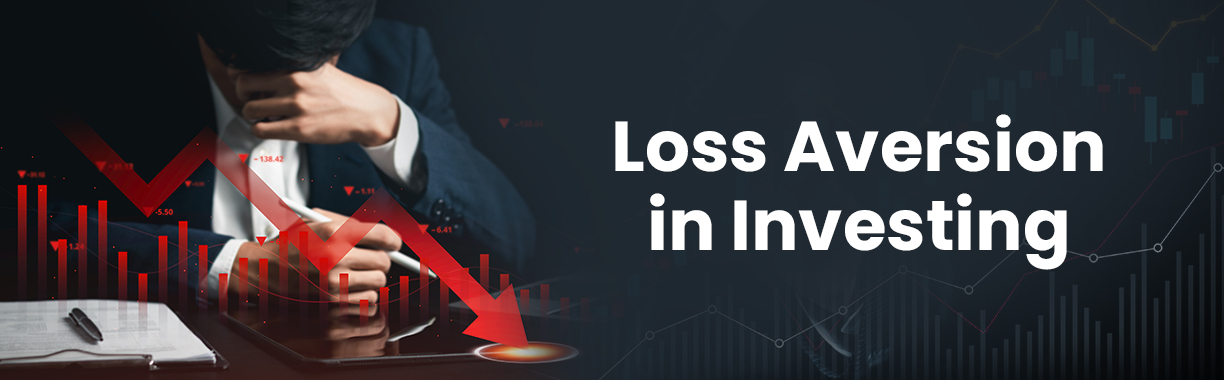
Investing is not just about numbers, charts, or returns. It is also deeply influenced by human behaviour. Human behaviour plays a central role in how investment decisions are made. Even when data and long-term logic point in one direction, emotional responses often push investors in another.
It is the most studies behavioural tendencies in finance is loss aversion, a concept that explains why the pain of losing money feels far stronger than the pleasure of gaining the same amount. For everyday investors, understanding how this tendency works is important because it quietly influences decisions such as when to buy, when to sell, and whether to stay invested during market volatility. This article explains the concept in simple terms, explores its effects on investment behaviour, and outlines practical ways to manage its influence.
What Does Loss Aversion Mean in Investments?
At its core, Loss aversion refers to the tendency to prefer avoiding losses rather than acquiring equivalent gains. In practical terms, losing ₹10,000 feels more distressing than the satisfaction gained from earning ₹10,000. Behavioural economists suggest that losses can feel roughly twice as powerful as gains.
Key characteristics of this behaviour
- Investors focus more on potential downside than potential upside
- Short-term market declines feel more significant than long-term growth prospects
- Decisions are often driven by fear rather than financial planning
The loss aversion meaning becomes clearer when viewed in daily investing scenarios. An investor may hold on to a falling stock hoping it will recover, while selling a rising stock too early to "lock in" gains. This response is not irrational in intent, but it often leads to outcomes that are misaligned with long-term goals.
Harmful Effects of Loss Aversion on Investment Decisions
When emotional discomfort outweighs rational assessment, investment choices can suffer. Loss aversion tends to influence behaviour most strongly during periods of market uncertainty.
This bias influences common decision-making patterns
- Avoiding equity investments despite suitable risk profiles
- Selling assets during market corrections to prevent further losses
- Delaying re-entry into markets after prices recover
Typical outcomes for investors
| Behaviour influenced by loss aversion | Resulting impact |
|---|---|
| Panic selling during downturns | Panic selling during downturns |
| Holding losing investments too long | Opportunity cost |
| Overweighting “safe” assets | Lower long-term returns |
This pattern of behaviour is often described as loss aversion bias, where emotional discomfort overrides strategic thinking. Over time, such decisions may reduce the effectiveness of an otherwise sound investment plan.
Adverse Impact on Long-Term Mutual Fund Returns
Mutual funds are designed for long-term participation, yet investor behaviour often works against this principle. Loss aversion plays a major role in why many investors fail to earn returns that match the funds they invest in.
How behaviour affects mutual fund outcomes
- Exiting equity funds after short-term underperformance
- Switching funds frequently in response to recent returns
- Avoiding systematic investments during volatile periods
Behaviour vs. outcome
| Investor action | Likely long-term effect |
|---|---|
| Likely long-term effect | Missed lower-cost investments |
| Switching funds based on recent performance | Inconsistent returns |
| Staying in cash for long periods | Inflation erosion |
A simple loss aversion example is an investor discontinuing a systematic investment plan during a market fall, only to restart it after markets have already recovered. The intention is to avoid loss, but the result is often reduced long-term compounding.
Impact on Different Types of Investment Behaviour
Not all investors react to losses in the same way, but Loss aversion influences behaviour across experience levels.
Typical behavioural responses
- Conservative investors may avoid growth assets altogether
- Moderate investors may react emotionally during volatility
- Experienced investors may still struggle during prolonged downturns
Common behavioural patterns
| Investor behaviour | Effect on portfolio |
|---|---|
| Frequent portfolio monitoring | Heightened emotional stress |
| Overreaction to short-term news | Unplanned asset allocation changes |
| Avoidance of volatility | Missed growth opportunities |
When you can recognise these patterns is the first step towards building discipline. While market movements cannot be avoided, emotional reactions can be managed with structure and awareness.
How to Overcome Loss Aversion for Better Investment Outcomes
Managing loss aversion does not need you to eliminate the emotion, but rather to create systems that reduce the impact of emotions.
Practical strategies investors can adopt
- Set clear investment goals and time horizons
- Use asset allocation to match risk capacity
- Rely on systematic investing rather than timing decisions
- Review portfolios periodically, not constantly
Behavioural safeguards
By focusing on process rather than the short-term outcomes, investors can gradually reduce the influence of emotional reactions on financial decisions.
Conclusion
The role of loss aversion in investing highlights how emotions and psychology shape financial behaviour. When it is left unaddressed, it can quietly undermine long-term financial outcomes. When you learn how this tendency shapes behaviour, if you are an investor, you can be equipped to make choices that are aligned with your goals rather than their fears.
A disciplined approach, supported by clear planning and periodic review, helps investors stay invested through market cycles. If you are reviewing your investment approach, consider focusing not only on products and returns, but also on the behavioural patterns that influence your decisions. Thoughtful awareness is often the first step towards better investing outcomes.
Frequently Asked Questions
1. Is loss aversion always harmful for investors?
Not necessarily. It can encourage caution, but problems arise when fear consistently takes over long-term planning.
2. Does experience reduce loss aversion over time?
Experience helps, but even seasoned investors can be influenced during extreme market conditions.
3. Can professional advice eliminate loss aversion completely?
Advice can help structure decisions, but emotional awareness remains important for every investor.
4. Is loss aversion linked to market volatility?
Yes. Volatile markets tend to amplify emotional responses and make losses feel more immediate.
Disclaimer: The contents herein are only for information and do not amount to an offer, invitation or solicitation to buy or sell securities or any other financial product offered by Indiabulls Securities Limited (formerly Dhani Stocks Limited / DSL). The content mentioned herein is subject to updation, completion, amendment without notice and is not intended for distribution to, or use by, any person in any jurisdiction where such distribution or use would be contrary to law or would subject Indiabulls Securities Ltd. (formerly Dhani Stocks Ltd. / DSL) to any licensing or registration requirements. No content mentioned herein is intended to constitute any investment advice or opinion. ISL disclaims any liability with respect to accuracy of information or any error or omission or any loss or damage incurred by anyone in reliance on the contents herein. This blog is based on information obtained from public sources and sources believed to be reliable, but no independent verification has been made about its accuracy or its completeness is guaranteed. This content mentioned in this blog is solely for informational purpose and shall not be used and/or considered as an offer or invitation or solicitation to buy or sell securities or other financial instruments. ISL will not treat recipients as customers by virtue of their receiving this report. The securities / Mutual Fund units (if any) discussed and opinions expressed in this blog/report may not be suitable for all investors. Such investors must make their own investment decisions, based on their investment objectives, financial positions and specific needs. ISL accepts no liabilities whatsoever for any loss or damage of any kind arising out of the use of this report. Past performance is not necessarily a guide to future performance. Investors are advised to see Risk Disclosure Document to understand the risks associated before investing in the securities markets. ISL may have issued other blogs that are inconsistent with and reach different conclusion from the information presented in this blog.
Indiabulls Securities Limited (formerly Dhani Stocks Limited) is a Mutual Fund Distributor registered with ‘Association of Mutual Fund of India’ (AMFI) vide ARN number ARN-160411. Corporate Identification Number: U74999DL2003PLC122874; Registered office address: A-2, First Floor, Kirti Nagar, New Delhi - 110008. Tel.: 011-41052775, Fax: 011-42137986.; Correspondence office address: Plot no. 108, 5th Floor, IT Park, Udyog Vihar, Phase - I, Gurugram - 122016, Haryana. Tel: 022-61446300. Email: helpdesk@indiabulls.com